Spark — Market Intelligence
Market Intelligence
Power trade-in programs with real-time market data. Connect your customers to a competitive buyer pool for higher conversion rates.
Capabilities
Uplevel your buyback program with insights from a trusted marketplace.
Live market prices
Access committed prices across a diverse buyer network for every model, capacity, and condition. These values ensure every device—pristine or broken— is backed by guaranteed liquidity.
Drive higher consumer trade-in and activation volume with market-leading pricing.
Historic pricing trends
Track asset valuation across time to identify depreciation curves by model, carrier, and condition. Use historical performance data to optimize refresh cycles and program pricing.
Maximize recovery by timing inventory disposition before market value erodes.
Connected APIs
Integrate instant quotes into your existing workflows via a REST API. Automate pricing logic for trade-in programs or internal inventory systems to digitize wholesale decision-making at scale.
Maximize net margins by automating high-frequency pricing decisions.
Customer experience
Integrated partnerships unlocking growth opportunities.
Our biggest win has been expanding into broken devices — the prices buyers compete for made it worth it. This has allowed Sellit9, a Canadian trade-in platform, to reach customers who wouldn't have considered selling their smartphones before.

Kyle Rogers
Head of CX & Operations · Sellit9
Use Cases
The infrastructure to better device lifecycle decisions.
Carriers
Set competitive consumer trade-in offers that drive device activations. Live market insights indicate your net recovered value, providing a floor price for consumers buybacks.
Learn more →Agents & Dealers
Drive customer stickiness by powering your buyback program with competitive buyer prices. Live market data outpaces closed system pricing and cement your end-customer relationships for future activations.
Learn more →Enterprise & Managed Services
Forecast asset recovery budgets and time fleet refreshes using historic pricing curves per device model. Close the loop with competitive broken hardware buyback prices.
Learn more →Third-party partners
Consumer trade-in programs shine with competitive pricing for lower end grades. Consolidate your value proposition with prices up to 50% above traditional liquidation channels.
Learn more →Why this matters
Real-time liquidity.
Most intelligence tools deliver static reports or historical estimates. A live, diversified buyer pool turns market data into executable transactions. The gap between valuation and settlement disappears. With committed demand visible across every condition grade, you capture immediate recovery on damaged units — without unnecessary repair cycles or the risk of over-processing devices.
Platform preview
Pull the trigger when it matters, don't let your stock value erode.
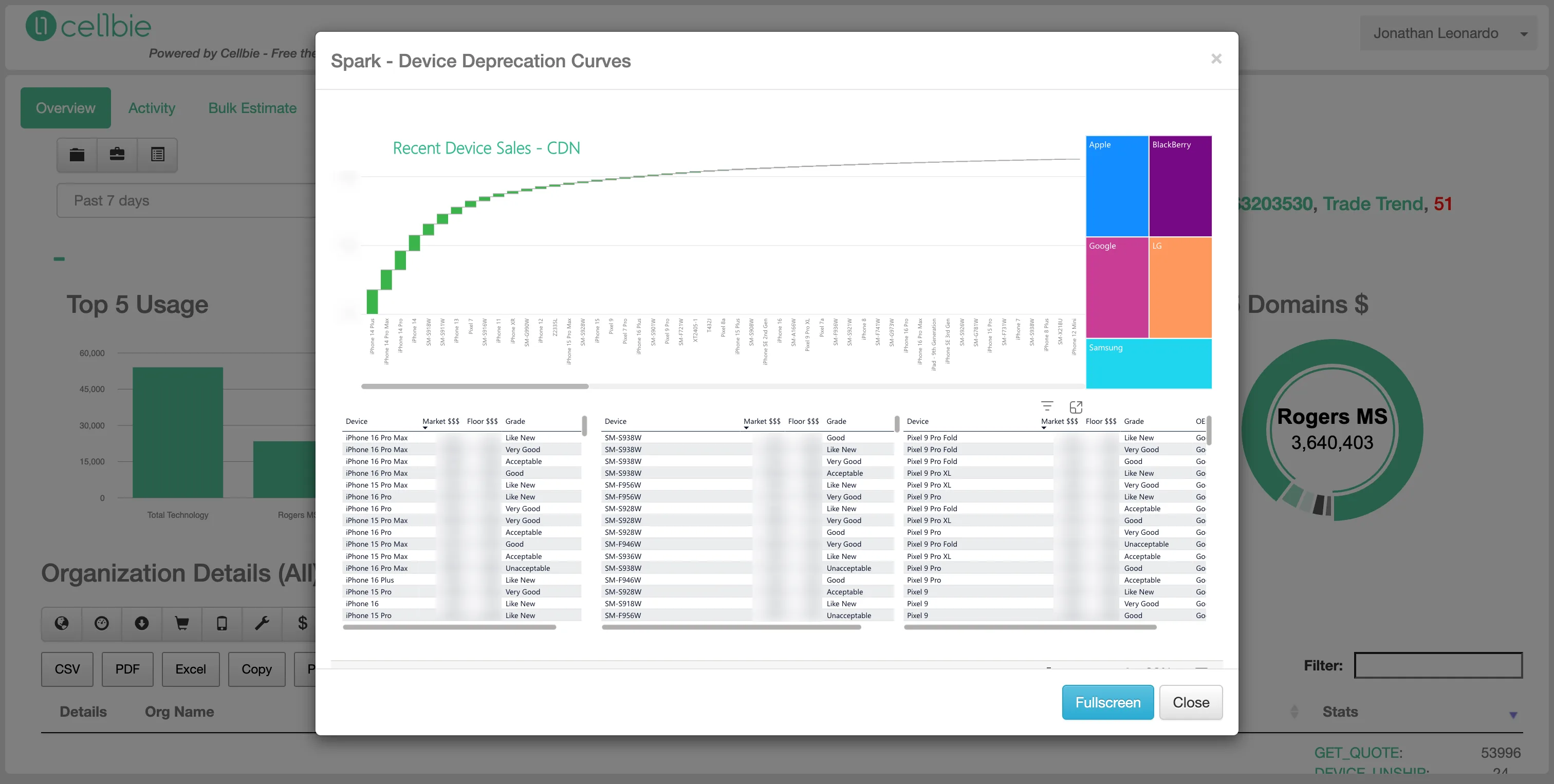
Historic depreciation curves — time your disposition before value erodes.
Live pricing
See what your inventory is worth.
Instant benchmarks for our most active device models and conditions. Dynamic data, subject to change.
Filter by brand, model, capacity and country to see current buyer prices by condition.
Integrations
Make smarter decisions with guaranteed prices.
Market Intelligence API
Pull real-time pricing data by model, memory, carrier, and condition into your own systems for data-informed decisions at any scale.
MCE Diagnostics
In partnership with MCE, Cellbie provides an end-to-end point-of-sale and bulk trade-in processing software — Spark pricing data surfaces directly within the MCE platform interface.
Custom integration
Connect current and past transaction data to your internal pricing workflows. Integrations are configured with Cellbie's team — contact sales to scope your setup.
Connect with proven refurbished market insights today.
FAQ
Common questions
What is Cellbie Spark?
Cellbie Spark is a market intelligence product that provides real-time and historic device pricing data. It pulls from Cellbie's live buyer network to surface what buyers are actively paying per model, memory, and condition. Spark is an API-accessible data product — it integrates with trade-in platforms, pricing engines, and internal tools rather than offering a standalone interface.
How is Spark pricing data different from benchmark reports?
Market benchmark reports aggregate historical data from multiple channels and typically lag behind real conditions by days or weeks. Spark pulls from Cellbie's live buyer network — what buyers are actively committed to pay right now, per device specification. Historic data in Spark also comes from actual transactions rather than survey-based estimates.
How do Carriers, Enterprises and Managed Services use Spark for trade-in programs?
Carriers, Dealers, Enterprises and Managed Services use Spark to determine what recovered value they can realistically achieve for any device before setting a consumer-facing buyback offer. With live market insights as input, trade-in program managers can set competitive offers that drive device more conversions, resulting in more activations.
Can Spark integrate with existing pricing systems?
Spark is API-accessible and is designed to integrate into existing pricing workflows — trade-in platforms, buyback pricing engines, or internal tools. Integrations are set up with Cellbie's team on a custom basis. There is no self-serve configuration. Contact sales to discuss integration scope and requirements.
What's the relationship between Spark and Cellbie's disposition products (One, Queue)?
Spark is a decision-support tool — it informs the decision before the transaction. One and Queue execute the transaction. A common workflow for buyback and trade-in operators: use Spark to see what the market will pay for a device → set a consumer offer accordingly → collect the device at that offer → dispose via One. Spark answers 'what's this worth?' One and Queue answer 'how do I sell it?'